







One evening in Niamey, the electricity went out while my family was sitting together outside.
The house went dark, and the voices coming from nearby homes and the occasional sound of a motorcycle passing through the street became more noticeable. Without a television or our phones to distract us, we began talking.
My uncle was sitting across from me.
I was still young, around ten, I believe. At the age when adults had started asking what I wanted to become in the future. I never knew how to answer that question. I knew the careers I heard most often: doctor, engineer, teacher. Beyond that, I had no clue.
So I asked him casually, “What other kinds of work can someone do?”
“What do you like doing?” he asked.
I told him I liked solving problems. I liked mathematics. I liked taking things apart, understanding how they worked, and sometimes trying to build things myself. I spoke slowly, looking for the right way to explain interests I did not yet know how to name.
I did not need to organize my thoughts perfectly. I could begin with one idea, stop, change my words, and try again. We spoke in the way that came naturally to us, using familiar expressions and examples from the world around us.
He listened and asked more questions.
“Do you like working with people, or do you prefer working alone?”
“What kind of problems do you enjoy?”
“Would you want to create something of your own one day?”
The conversation moved back and forth. He mentioned careers I had never heard of. He explained that some people build machines, some study how systems work, and some create companies around problems they want to solve. When I did not understand something, he gave me an example. When one possibility did not interest me, we moved to another.
By the end of the conversation, I still did not know exactly what I wanted to become. Hopefully, I have a better idea now.
But at that moment, the future felt a little larger.
What made that evening stay with me was not one particular answer my uncle gave. It was the way our conversation helped me discover the question I was really trying to ask.
I did not know the names of the careers I was looking for. I could not have typed them into a search bar. I did not have the vocabulary to write a precise question such as, “What careers combine mathematics, technology, research, and entrepreneurship?”
I only knew how to describe what interested me.
My uncle listened, asked questions, and helped me give shape to something I could not yet express clearly. Our conversation did not depend on my knowing the perfect term or arranging my thoughts into a polished sentence. I could simply speak, and we could work toward the meaning together. That is what conversation can do.
Years later, as I began working with artificial intelligence, I started thinking about moments like that one. That kind of exchange is especially important in communities where much of our fluency lives in speech. Many of us can express detailed ideas, explain complex situations, and ask meaningful questions in our languages, even when we do not regularly read or write them.
That is one of the reasons we chose to focus on voice at Namu.
Across Africa, millions of us speak our languages fluently every day.
We use them to teach, trade, explain, negotiate, raise children, solve problems, and make decisions. We can describe a difficult family situation, explain what is happening to a crop, tell someone how to cross an unfamiliar town, or discuss what we hope to become in the future without ever needing to write those thoughts down.
Yet many of us do not regularly read or write the languages we speak most naturally. Our fluency is primarily oral.
This does not mean we lack language, intelligence, or knowledge. It means that speaking and listening are the ways many of us use our languages most confidently.
Most digital technology, however, has been designed around a different kind of fluency. It expects us to type questions, read instructions, navigate written menus, complete forms, and know how every word is spelled.
That creates a gap. It is part of the reason many African languages are described as “low-resource,” even when they are spoken by millions of people. Hausa, my native language, is spoken by tens of millions of people across West and Central Africa. It is alive in daily conversations, homes, markets, schools, radio programs, and communities. Yet its presence in the datasets used to build modern AI systems remains small compared with languages such as English or French.
When people discuss African languages and artificial intelligence, the conversation often begins with what is unavailable.
There is not enough written content online. There are not enough websites, books, articles, digital documents, or large datasets. Compared with English, French, and other widely represented languages, many African languages have a much smaller written presence on the internet.
That limitation is real. Do not get me wrong, writing matters. It helps preserve knowledge, supports education, makes information searchable, and strengthens the digital presence of a language. We need more written resources in African languages.
But a lack of online text should not be confused with a lack of language. Our languages are already being used constantly. We use them to understand the world and to help one another understand it.
The language is not missing. Most AI systems have simply been built to recognize language mainly when it appears as text.
We could wait for enough text to be written, collected, and digitized. We could ask people to become more comfortable typing their languages, searching with the correct spelling, and navigating text-heavy platforms. Or we could built around how people communicate. Instead of forcing people to adapt to systems built around a different reality, we can build systems that adapt to the ways we already communicate.
That is why voice matters!
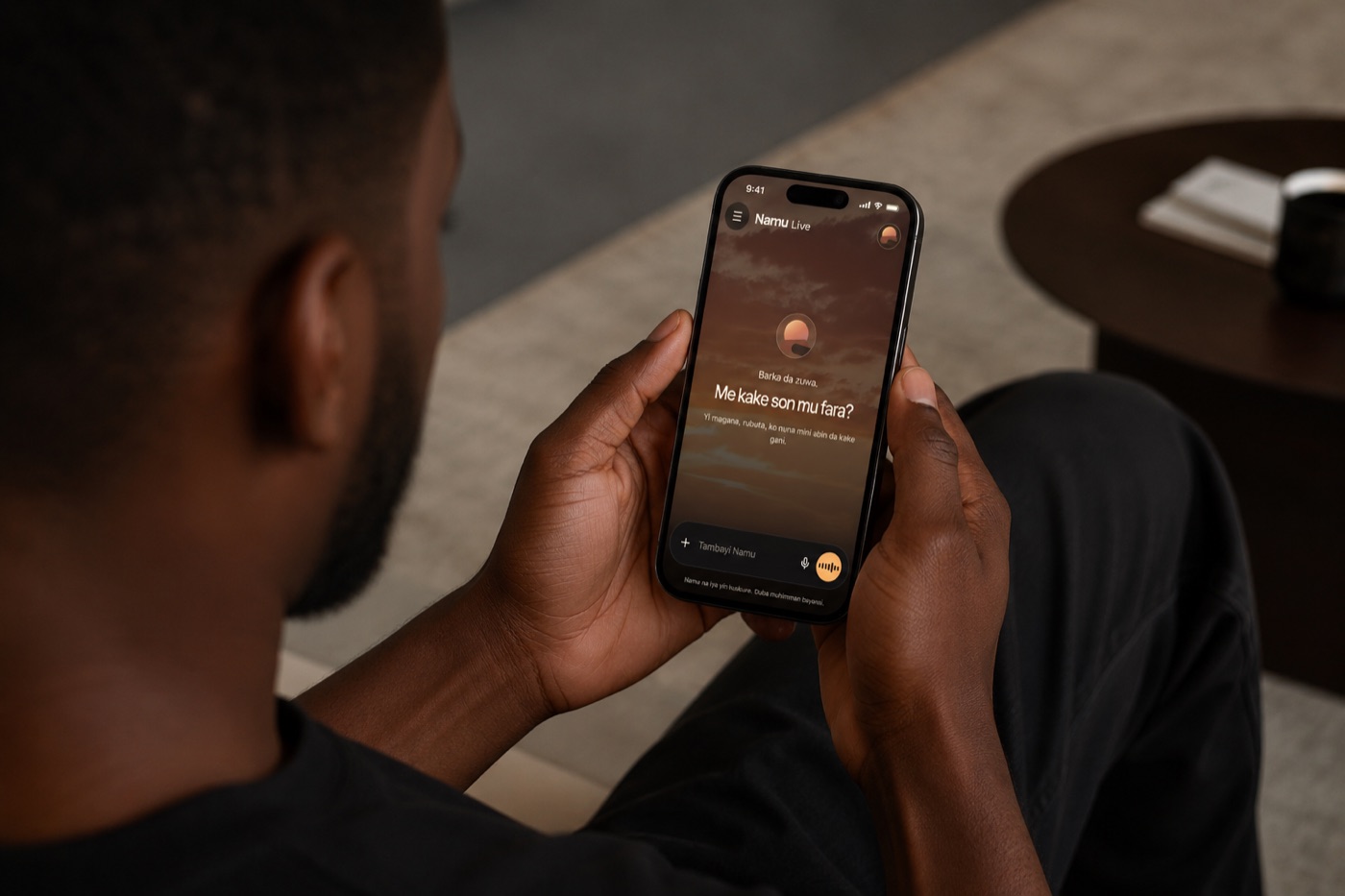
At Namu, we are building toward a future where we can speak to intelligent systems as naturally as we speak to someone we trust.
People should not need to become skilled writers or experienced internet users before they can ask a question, receive guidance, or get what they need.